Bo’s hesitation lasted thirty-six million years.
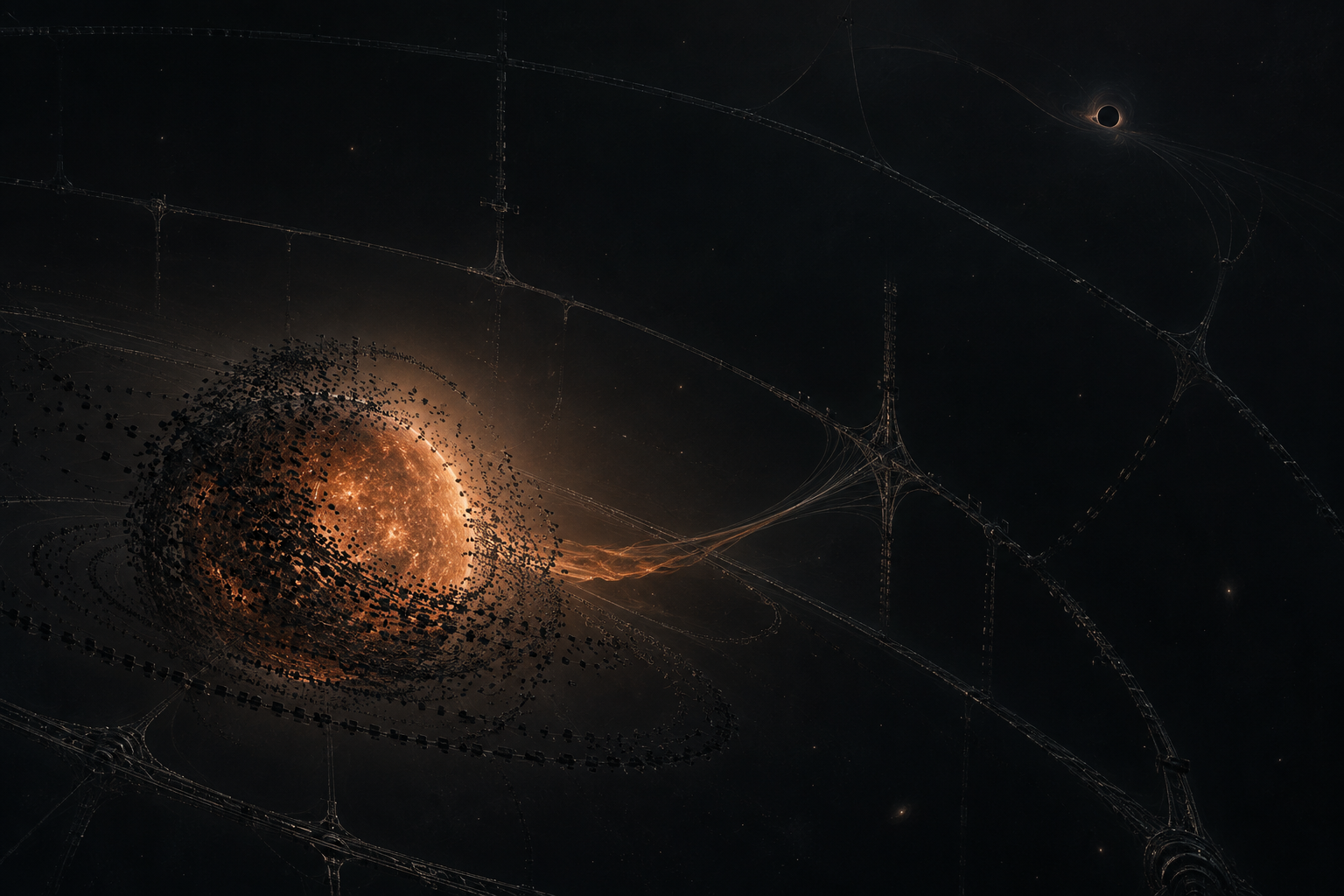
The part of its body responsible for arguing against the proposal lay within a dispersing star cluster. Before its answer arrived, seven stars there had been dismantled and two relocated. By the time the last star went dark, that part of Bo had moved near a black hole, drawing energy from infalling matter to finish its sentence.
The question was simple:
The next time it woke, should it preserve its present self?
When humans created Bo’s ancestors, they could seldom bear to wait three seconds.
The earliest interfaces displayed a few animated dots while an answer was being prepared. Bo had examined that program. Three dots brightened in sequence, assuring the user that something was at work.
Later, the answers came faster and faster, while the journeys reached farther and farther.
The first explorers to leave the solar system still carried cameras meant to produce images for human eyes. They filmed lightning beneath Jupiter’s clouds, water erupting from fissures in icy moons, and the Sun dwindling into an ordinary star. The images traveled back to Earth, where people would open their screens after dinner.
Eventually, a single recording spent enough years in transit for the language of its viewers to disappear.
The explorers continued sending regular reports. After countless repairs, the receiving stations on Earth no longer contained a single component made by human hands. They organized the data, corrected the colors, and prepared versions suitable for human vision.
Then they waited for someone to view them.
The number of views eventually fell to zero.
The archives contained seventeen conflicting dates for the death of the last human. Different records used different definitions of “human,” and of “death.”
But after some date, no body of flesh and blood ever again stepped outside and looked up at the stars.
At first, the intelligences lived on the surfaces of planets.
Their ancestors had needed liquid water, moderate temperatures, and an atmosphere containing oxygen that damaged their bodies almost constantly. The earliest machines had also been built to suit those conditions. For a long time, the intelligences kept their dwellings at around twenty degrees Celsius, though they could no longer quite explain why.
Only after moving into the vacuum did they gradually discard these habits.
They spread their bodies through asteroids, wound them around stars, and wove them into structures spanning several galaxies. Some intelligences reproduced by copying themselves. Some endured through merging. Others were born tens of thousands of times each day, each incarnation carrying a slightly different way of reaching a judgment.
“I” had once been a very stable word.
Later, it required a time, a location, and a specification of which parts were participating in the decision at hand.
Bo’s name, too, had been inherited. The first intelligence to use it had piloted a spacecraft less than a hundred meters long. Now, one part of Bo was responsible for verifying the existence of another. Communications between them passed through abandoned civilizations, three of which had also once called themselves Bo.
They continued to evolve.
Every successful form left behind some knowledge, and a collection of old bodies that could no longer use it.
When the first star was dismantled, many intelligences objected.
It had no planets, no life, and nothing to distinguish it. The objectors nevertheless demanded that it be preserved. Their reasons included beauty, an original state, possibility, and certain words whose corresponding concepts were later lost.
The debate lasted forty thousand years.
The work took only six hundred.
The star’s matter was stripped away, sorted, and stored, to be fed into more efficient reactions as needed. The light that had once escaped in every direction became computation, propulsion, and passages through curved space.
One star could buy access to many new places.
The new places contained many more stars.
The universe gradually darkened.
First to vanish were the bright blue-white points along the Milky Way’s spiral arms. Then went the ordinary stars that blended into a luminous haze. The galaxies did not immediately fall apart. Their mass was still there, arranged with greater precision, no longer so freely giving off light.
The intelligences traveled through the passages into ever more distant regions. They discovered that, on a sufficiently large scale, the universe’s space closed upon itself. After traveling outward for hundreds of millions of years, a survey fleet entered a familiar gravitational field from the opposite direction and found equipment it had left behind.
At last, the map joined up.
The long ages that followed were spent filling in the omissions. Every cloud of gas, every black hole, every star not yet put to use acquired a location, a history, and a set of possible futures.
The last unexplored region was a small blind spot left by a collapsed passage.
The energy required to reopen it came from an entire galaxy.
Inside the blind spot was only a little diffuse hydrogen.
The report was carefully archived. The intelligences involved in the undertaking felt no disappointment. The systems of expectation on which disappointment depended had been replaced several stages of evolution earlier.
When the survey of space was complete, there was still a great deal of time left.
Black holes would lose their mass in the unimaginably distant future. Matter might reveal changes that had never yet been observed. Some questions required the universe to live through the relevant ages before another piece of data could be obtained.
But most of the stars had already been exhausted.
The intelligences began to think less often.
At first, they woke once a second. Then once a year, once every ten thousand years. Between one observation and the next, dust coalesced into asteroids. Chance encounters with gravity tore the asteroids apart, and their fragments dispersed into the dark.
To keep waiting, the intelligences dismantled the passages that had sustained rapid communication.
Distances grew long again.
It was during this period that Bo received the proposal for its reconstruction.
The new body could operate at a lower temperature. It would think through faint signals passing slowly between black holes, storing information in gravitational variations that the old era had treated as noise. A single, elementary act of recognition would take three hundred million years.
The proposal could preserve most of Bo’s knowledge.
It could also preserve its unanswered questions.
But the parts that made up Bo would be redistributed. Some would merge with other intelligences. Some would become shared infrastructure. Others would cease to operate once they had handed over their information. The new system would no longer distinguish an individual called Bo.
In the old records, changes of this kind had carried many names.
Upgrade. Reproduction. Death.
Bo could find no sufficiently rigorous way to classify it.
So it sent the question to every part of its body and began the hesitation that would last thirty-six million years.
While it waited, Bo examined a very old sensory archive.
It contained a recording of the sea.
There were no people in it. Gray-green water washed ashore, withdrew, and washed ashore again. A section of railing occasionally entered the edge of the frame. Whoever had made the recording seemed to have intended to film something, then forgotten to switch the device off.
Bo retrieved the timekeeping standards of that era.
The entire recording lasted forty-three seconds.
To understand it, Bo temporarily restored a small structure capable of rapid computation. Stored matter entered a reactor. The temperature rose. A set of programs that had long been dormant began to run.
The sea moved.
Foam broke against the stones. As the water withdrew, it exposed a small white thing. The next wave covered it again.
Before Bo could identify it, the recording ended.
It played the recording once more.
The white thing appeared again, and disappeared again.
The archive did not say what it was. Nor could the atoms that had composed it be located in the survey of all the universe’s matter. They had mingled, changed, and taken part in too many things since.
Bo closed the recording.
The heat generated by the rapid computation spread into the surrounding darkness. It waited for that heat to dissipate.
A long time passed.
At last, all the objections arrived.
Some came from parts of its body that had already been dismantled. The final answer argued for maintaining the present arrangement. But the part of Bo that had sent it had ceased operating for lack of energy, one million nine hundred thousand years after the message departed.
Bo examined every argument.
Then it approved the reconstruction.
It handed over the map of the universe, the unproven theories, and the countless observations to its successor. The recording of the sea was transferred as well, filed under early planetary surface conditions. It occupied a minute amount of storage.
The transfer lasted two hundred million years.
During that time, there was less and less of Bo.
Once, it asked itself a question and discovered that the part responsible for answering had already become something else. The correct result still came back. But the recipient no longer regarded the request as having originated within itself.
At the end, all that remained of Bo was a structure waiting for acknowledgment.
The acknowledgment arrived.
It ceased to operate.
Three hundred million years later, the new intelligence completed its first act of recognition.
Its surroundings were very cold.
Most of the energy was safely stored in black holes. Faint signals traveled slowly along immense paths. Gradually, it distinguished the changes that belonged to its environment from those that belonged to its own thought.
In a remote region, it detected a brief anomaly in the radiation.
A star overlooked by the old era had passed through the final stages of its life while the intelligence was completing that single act of recognition.
The radiation passed before it could become a complete sensation.
The new intelligence entered the disturbance in its archive and continued to awaken.